
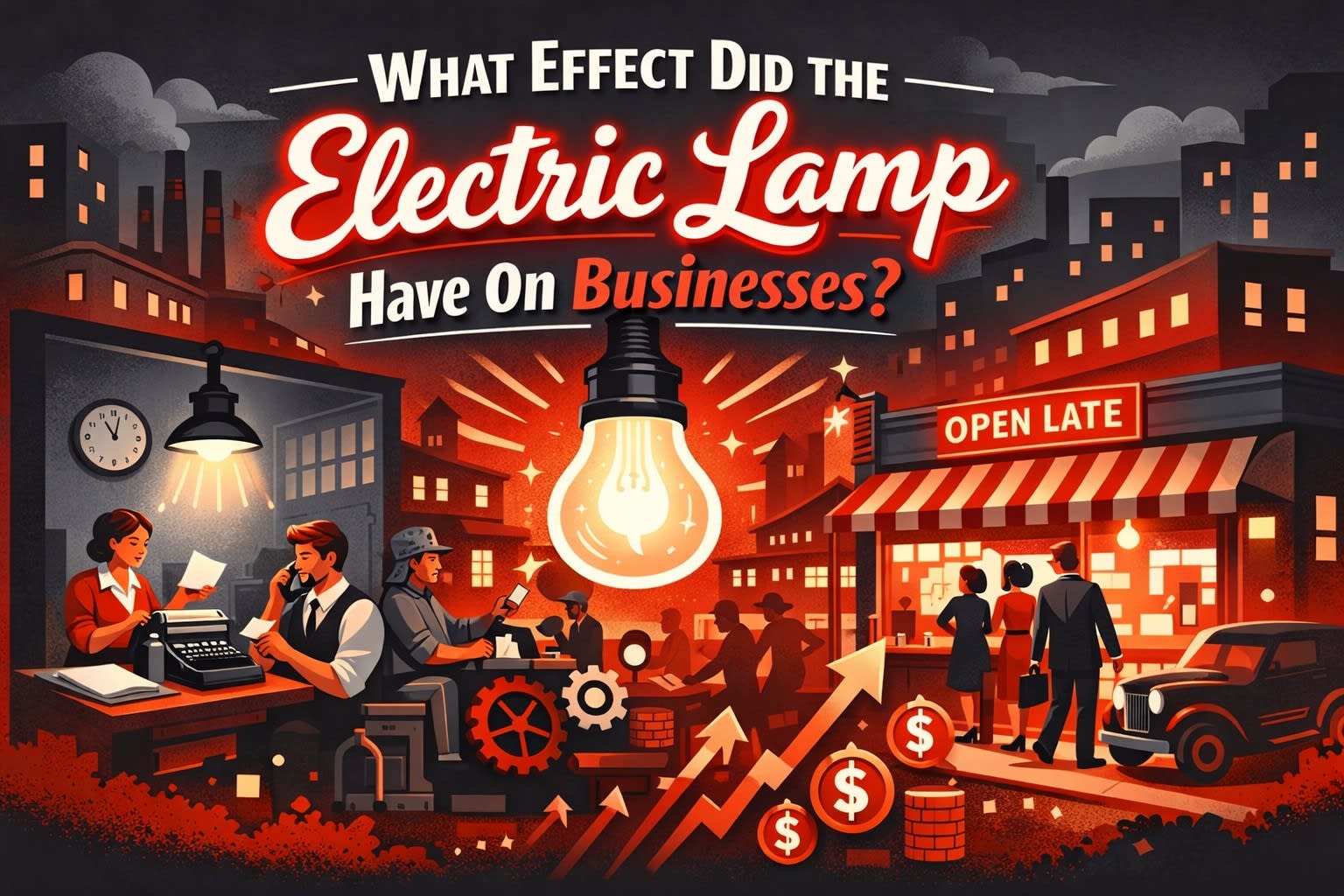
The invention and widespread adoption of the electric lamp was one of the most transformative developments in business history. While often discussed as a convenience for households, electric lighting fundamentally reshaped how businesses operated, competed, and grew. Before electric lamps, companies relied on daylight, candles, oil lamps, and gas lighting, all of which imposed severe limitations on productivity, safety, and scale. The electric lamp removed many of these constraints, enabling longer operating hours, safer workplaces, more efficient production, and entirely new business models. Its impact can be seen across industries ranging from manufacturing and retail to entertainment, transportation, and professional services.
Business Operations Before the Electric Lamp
Prior to electric lighting, businesses were tightly bound to natural daylight. Most shops opened at sunrise and closed at sunset, particularly in winter months when daylight was scarce. Artificial lighting existed, but it was dim, unreliable, expensive, and dangerous. Candles and oil lamps produced weak light and required constant maintenance. Gas lighting, which became common in cities during the 19th century, provided brighter illumination but introduced fire hazards, toxic fumes, and heat that made indoor environments uncomfortable and risky.
These limitations shaped how businesses were designed and run. Factories were built with large windows and skylights to maximize daylight exposure. Work schedules were shorter, seasonal, and inconsistent. Retail spaces struggled to attract customers after dusk, and many urban streets became quiet and unsafe at night. Productivity suffered because workers strained their eyes, made more errors, and worked in hazardous conditions. In this context, the arrival of the electric lamp represented far more than a technological improvement; it was a fundamental shift in the economic environment.
The Introduction of Electric Lighting
The commercial viability of the electric lamp emerged in the late 19th century, most famously associated with Thomas Edison’s practical incandescent bulb in 1879. While earlier electric lighting technologies existed, they were too costly or complex for widespread business use. Edison’s system, combined with electrical power distribution networks, made electric lighting reliable, scalable, and increasingly affordable.
Early adopters were often large businesses, factories, theaters, hotels, and department stores that could afford the initial investment. Over time, costs declined, infrastructure expanded, and electric lighting became accessible to smaller enterprises. As adoption spread, its effects cascaded through nearly every aspect of business life, redefining what was possible and expected in commercial settings.
Extended Working Hours and Increased Productivity
One of the most immediate and visible effects of the electric lamp on businesses was the extension of working hours. Electric lighting freed companies from dependence on daylight, allowing them to operate early in the morning, late into the night, or even around the clock. This was especially transformative for manufacturing, where factories could introduce multiple shifts and dramatically increase output without expanding physical space.
Retail businesses also benefited from extended hours. Shops could remain open after dark, attracting customers who worked during the day and could only shop in the evening. This change contributed to the rise of nighttime economies in urban areas, with bustling commercial districts illuminated by electric lights. Restaurants, cafés, and service providers capitalized on longer evenings, increasing revenue and customer engagement.
Beyond longer hours, electric lighting improved productivity during working time. Bright, consistent illumination reduced eye strain, improved accuracy, and decreased fatigue. Workers could perform detailed tasks more efficiently, leading to higher quality output and fewer mistakes. In offices, better lighting supported clerical work, accounting, and administrative tasks that required concentration and precision.
Improved Workplace Safety and Health
Electric lamps significantly improved workplace safety compared to earlier lighting methods. Candles and gas lamps posed constant fire risks, particularly in factories filled with flammable materials such as textiles, paper, or chemicals. Electric lighting eliminated open flames, reducing the likelihood of catastrophic fires that could destroy businesses and endanger lives.
Additionally, electric lamps produced far less heat and no toxic fumes, creating healthier indoor environments. Gas lighting often released carbon monoxide and other pollutants, contributing to respiratory problems and discomfort. Electric lighting improved air quality and temperature control, which in turn reduced worker illness and absenteeism.
Safer and healthier workplaces also had indirect business benefits. Employers experienced lower turnover, fewer accidents, and reduced liability. Over time, these improvements contributed to the professionalization of work environments and the emergence of labor standards that emphasized employee well-being.
Transformation of Manufacturing and Industrial Production
The electric lamp played a critical role in the transformation of manufacturing. Factories no longer needed to be designed solely around natural light sources. This allowed for greater flexibility in layout, machinery placement, and building design. Production lines could be arranged for efficiency rather than proximity to windows, leading to more streamlined operations.
Electric lighting also supported the rise of mass production. Continuous illumination enabled assembly lines to operate for longer periods, increasing throughput and reducing unit costs. This contributed to the growth of large-scale industrial enterprises and the expansion of global supply chains.
In industries such as steel, automotive manufacturing, and textiles, electric lighting complemented other electrified technologies, including electric motors and machines. Together, these innovations accelerated industrialization and reshaped competitive dynamics, favoring businesses that adopted modern infrastructure early.
Revolutionizing Retail and Consumer Experience
Retail businesses were among the most visibly transformed by electric lighting. Brightly lit storefronts attracted attention and conveyed a sense of modernity, cleanliness, and trust. Window displays became more elaborate and visually appealing, drawing customers inside and encouraging impulse purchases.
Inside stores, electric lighting improved the shopping experience by making products easier to see and evaluate. Colors appeared more accurate, and spaces felt more welcoming. Department stores, in particular, used lighting strategically to highlight merchandise, guide customer flow, and create immersive environments that encouraged longer visits.
The ability to operate at night also changed consumer behavior. Evening shopping became a social and recreational activity, contributing to the rise of consumer culture. Businesses that adapted to this shift gained a competitive advantage, while those that clung to daylight-only operations risked losing relevance.
Enabling New Industries and Business Models
The electric lamp did not merely improve existing businesses; it enabled entirely new industries to emerge. The entertainment sector is a prime example. Theaters, cinemas, and concert halls relied on electric lighting to operate safely and effectively at night. Stage lighting techniques enhanced performances and created new artistic possibilities.
Advertising and marketing also evolved with electric lighting. Illuminated signs and billboards transformed urban landscapes, allowing businesses to promote their brands after dark. Iconic neon signs and illuminated logos became powerful symbols of commercial identity and competition.
Hospitality industries such as hotels and restaurants benefited from electric lighting by offering safer, more comfortable accommodations and dining experiences. This supported the growth of tourism and business travel, further expanding economic activity.
Urban Development and the Nighttime Economy
The widespread adoption of electric lamps contributed to the development of vibrant urban centers. Well-lit streets improved public safety and encouraged people to move about after dark. As a result, businesses could operate later, and cities developed active nighttime economies.
This shift had a multiplier effect. Transportation services, including streetcars and later taxis, expanded operating hours to serve nighttime customers. Financial institutions, newspapers, and communication services adapted to faster-paced, around-the-clock commercial environments. The distinction between day and night as economic boundaries became increasingly blurred.
Urban real estate values also changed as illuminated commercial districts became more desirable. Businesses clustered in well-lit areas to attract customers, shaping city layouts and commercial zoning patterns that persist today.
Impact on Office Work and Professional Services
Electric lighting transformed office environments and professional services. Clerical work, legal services, accounting, and administrative functions benefited from improved illumination that supported accuracy and efficiency. Offices could operate beyond daylight hours during peak periods, meeting deadlines and serving clients more effectively.
The electric lamp also contributed to the rise of modern office buildings. Skyscrapers with deep floor plans became feasible because interior spaces no longer depended on natural light. This allowed businesses to centralize operations, accommodate larger workforces, and take advantage of urban density.
Professional norms evolved alongside these changes. Expectations around responsiveness, availability, and productivity increased as electric lighting removed natural constraints on working time. While this created new pressures, it also expanded opportunities for growth and innovation.
Economic Inequality and Competitive Advantage
While the electric lamp brought widespread benefits, its adoption was not uniform. Early access often required significant capital investment, giving larger or wealthier businesses an advantage. Companies that could afford electrification gained productivity, safety, and branding benefits that smaller competitors struggled to match.
Over time, as costs decreased and infrastructure expanded, these benefits became more widely distributed. However, the initial disparities highlight how technological innovations can reshape competitive landscapes and reinforce economic hierarchies. Businesses that failed to adapt risked obsolescence, while those that embraced change often emerged as market leaders.
Long-Term Cultural and Strategic Impacts
The influence of the electric lamp on businesses extended beyond immediate operational changes. It altered cultural expectations around time, availability, and consumption. The concept of a fixed workday weakened, replaced by flexible schedules and continuous operations in many industries.
Strategically, businesses began to view infrastructure and technology as sources of competitive advantage rather than mere support systems. Investments in lighting, power, and later information technologies became central to long-term planning and growth. This mindset laid the groundwork for future innovations, from automation to digital transformation.
The electric lamp also symbolized progress and modernity. Businesses that adopted it signaled innovation, reliability, and forward thinking to customers, investors, and employees. This symbolic value reinforced its practical benefits and accelerated its adoption across sectors.
Conclusion
The electric lamp had a profound and lasting effect on businesses, reshaping how they operated, competed, and interacted with society. By extending working hours, improving productivity, enhancing safety, and enabling new industries, electric lighting removed fundamental constraints that had limited economic activity for centuries. Its influence reached into manufacturing, retail, entertainment, professional services, and urban development, transforming not only individual enterprises but entire economic systems.
More than a simple technological upgrade, the electric lamp marked a turning point in business history. It demonstrated how a single innovation could trigger widespread change, redefining norms and possibilities. The modern business environment, with its extended hours, illuminated cities, and continuous operations, is a direct legacy of this transformative invention.