
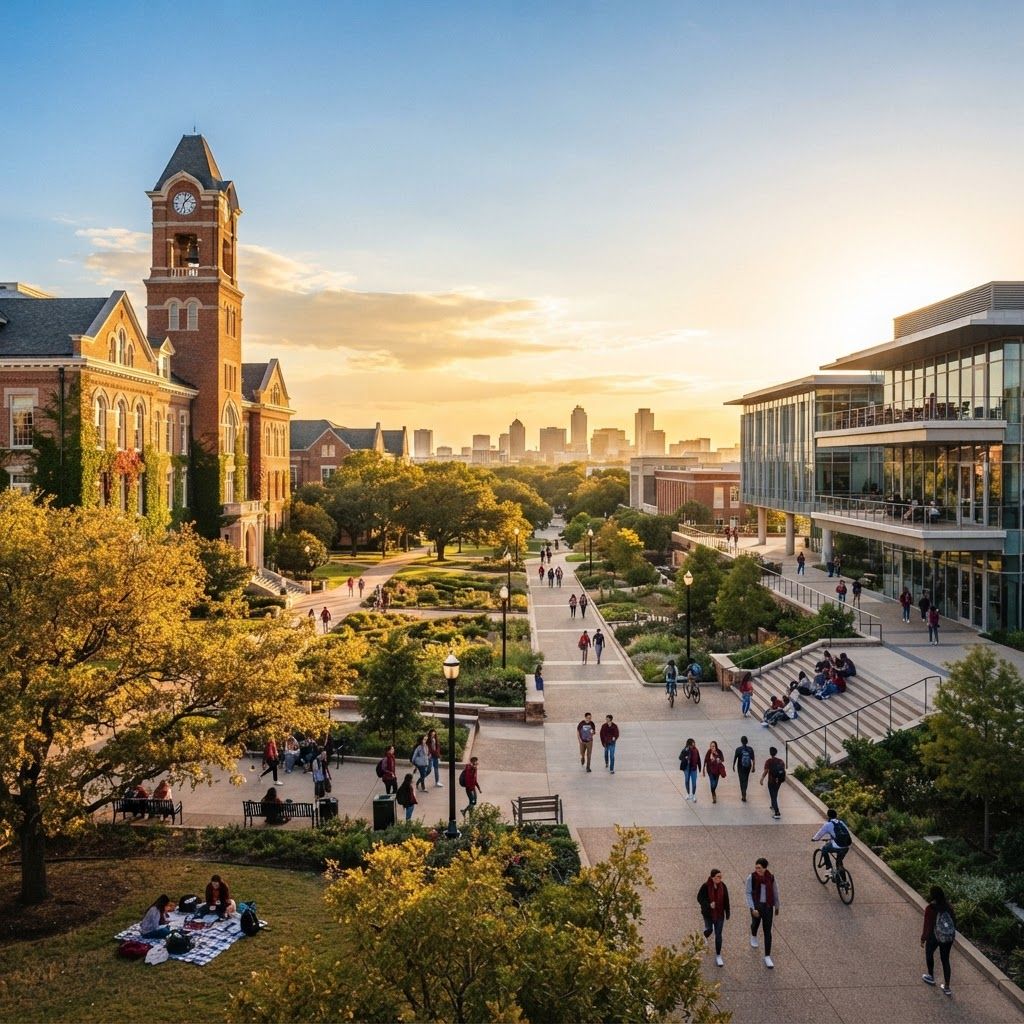
Fort Worth's University Landscape
Fort Worth supports a distinctive mix of higher-education institutions. Students can choose a nationally visible private campus, smaller teaching-focused universities, public branch locations, a health-science center, and specialized professional schools. Nearby universities also expand options for commuters across the western Dallas-Fort Worth region.
This guide prioritizes relevance to Fort Worth students rather than claiming a universal academic ranking. Programs, tuition, admissions, and delivery locations evolve. Prospective students should verify details with each institution and compare outcomes for the exact degree under consideration.
1. Texas Christian University
Texas Christian University is Fort Worth's best-known comprehensive university. The private institution offers undergraduate and graduate programs across business, liberal arts, nursing, communication, education, science, engineering, and fine arts. Its residential campus, major athletics, alumni network, and extensive student organizations create a traditional university experience. Applicants should evaluate net price and program-level strengths rather than reputation alone.
2. Texas Wesleyan University
Texas Wesleyan University offers a smaller private setting with roots in Fort Worth. Its size can support closer faculty relationships and a more personal campus environment. Academic options include business, education, health-related fields, and liberal studies, with graduate and professional pathways as well. It may suit students who value individual attention and connection to the city.
3. University of North Texas Health Science Center at Fort Worth
The University of North Texas Health Science Center is a major graduate health institution located in Fort Worth's Cultural District. It educates physicians, pharmacists, public-health professionals, researchers, and other health specialists. Research and clinical partnerships connect students to the region's healthcare ecosystem. Applicants should examine professional accreditation, clinical placements, residency outcomes, and total program cost.
4. Tarleton State University Fort Worth
Tarleton State University's Fort Worth campus provides public university access in the rapidly growing southwest portion of the city. It serves transfer, graduate, and nontraditional students through selected programs and flexible formats. The campus is valuable for learners seeking a recognized public institution without relocating. Students should confirm course rotation and where required classes are delivered.
5. Texas A&M University School of Law
Texas A&M University School of Law gives Fort Worth a prominent professional law institution downtown. Students can gain practical experience through clinics, advocacy, externships, and proximity to legal and business organizations. Law applicants should compare employment outcomes, bar passage, experiential offerings, scholarship renewal conditions, and projected debt.
6. University of Texas at Arlington
The University of Texas at Arlington is a large public research university within commuting distance of Fort Worth and also maintains selected activity in the city. Its breadth includes engineering, nursing, business, science, social work, architecture, and many other disciplines. UTA can offer substantial research resources and diverse student communities, though commute and class location should factor into planning.
7. University of North Texas
The University of North Texas in Denton is farther from central Fort Worth but remains an important regional option. It offers a wide range of undergraduate, graduate, arts, business, education, science, and technical programs. UNT is particularly recognized for its music and creative disciplines. Fort Worth-area students should compare residential living with the time and cost of commuting.
8. Texas Woman's University
Texas Woman's University is a public institution headquartered in Denton and historically known for health sciences, education, nutrition, and programs supporting professional advancement. It welcomes students of all genders. Its regional location and graduate offerings make it relevant to Fort Worth residents, especially those pursuing healthcare or education careers.
9. Dallas Baptist University
Dallas Baptist University sits east of Fort Worth but serves students across the Metroplex through undergraduate, graduate, and adult education. Its Christian identity, hilltop campus, and professional programs distinguish it from secular public institutions. Prospective students should evaluate the commute, faith environment, financial aid, and whether the preferred program is delivered in person or online.
10. Southwestern Baptist Theological Seminary
Southwestern Baptist Theological Seminary is a specialized Fort Worth institution for theological, ministry, and worship education. Through its collegiate and graduate programs, it prepares students for church leadership, missions, scholarship, and related vocations. Fit depends heavily on theological alignment and career calling, making faculty, community, and denominational context important considerations.
Evaluating Academic Quality and Value
University-wide averages can hide meaningful differences between programs. Review curriculum, faculty experience, class access, labs, clinical placements, internships, accreditation, and recent graduate outcomes for the intended major. Ask current students whether required courses are available when needed and whether advising helps them graduate efficiently.
Calculate net cost after grants and scholarships, then include housing, transportation, fees, books, and supplies. Understand scholarship renewal requirements and likely annual increases. For graduate or professional study, compare debt with realistic earnings and examine assistantships, employer benefits, or public-service pathways.
Finding the Right Campus Fit
Students thrive in different environments. Some want a spirited residential campus with athletics and traditions; others need evening classes near work. Research universities may offer extensive facilities but larger introductory courses, while smaller institutions may provide stronger personal attention with fewer majors. Online flexibility can be valuable, but it requires self-management and should not be confused with reduced academic rigor.
Visit during a normal class day, tour the department rather than only the central campus, and speak with students who share the intended major. Fort Worth's universities connect learners with healthcare, aerospace, logistics, education, arts, legal, and business opportunities across the Metroplex. The best choice will combine credible academics, manageable cost, a supportive environment, and a clear route from enrollment to graduation and employment.