
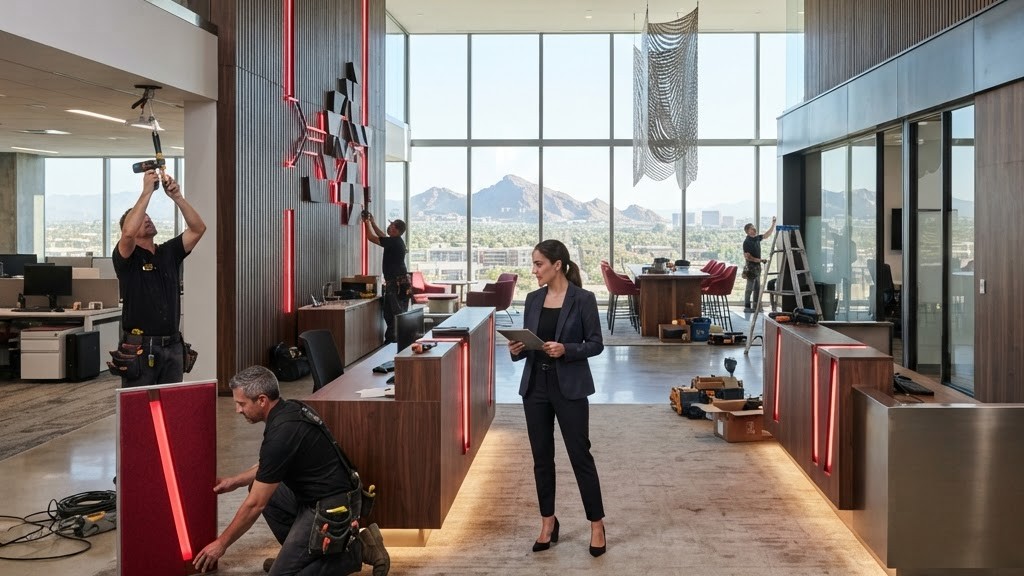
Turning Commercial Space into a Working Environment
An interior fitout converts a shell or outdated suite into a space that supports people, brand, technology, and operations. In Phoenix, the sector includes corporate headquarters, medical suites, restaurants, resorts, retail, laboratories, and industrial offices. Successful teams coordinate design, permits, mechanical loads, electrical and data systems, life safety, acoustics, furniture, signage, and move-in. The companies below bring different strengths to tenant improvements and commercial interiors across the Valley.
1. Stevens-Leinweber Construction
Stevens-Leinweber Construction has deep experience in Phoenix office and industrial interiors. Its familiarity with commercial real estate, property managers, and tenant schedules can support fast preconstruction and practical phasing. The company is especially relevant to corporate offices and improvements connected to larger industrial assets.
2. Wespac Construction
Wespac delivers tenant improvements and hospitality, office, retail, and healthcare projects. Breadth across finish-intensive sectors supports detailed coordination among millwork, lighting, specialty ceilings, and building systems. Owners should review examples matching the desired quality level and operational constraints.
3. Jokake Construction
Jokake Construction works on corporate, institutional, healthcare, and public interiors throughout Arizona. Experience in active facilities helps when noise, dust, shutdowns, access, and security require careful control. A detailed logistics plan can be as important as the visual design.
4. Willmeng Construction
Willmeng Construction provides commercial and municipal building services, including tenant improvements. Its local network and preconstruction capability suit projects with strict occupancy dates. Early coordination with landlords and base-building teams helps clarify responsibilities for utilities and shared systems.
5. Layton Construction
Layton brings large-contractor resources to sophisticated commercial and hospitality interiors. This can benefit complex projects with extensive procurement, technology, or specialty trades. The proposed team's fit remains important because interiors demand rapid decisions and close daily supervision.
6. CHASSE Building Team
CHASSE Building Team handles commercial, education, and community-focused environments. Its collaborative approach can support spaces with many users and stakeholders. Education and nonprofit fitouts often require durable finishes, budget discipline, and schedules aligned with fixed opening dates.
7. RSG Builders
RSG Builders is active in Arizona commercial construction and tenant improvements. A focused local contractor may offer responsive leadership and flexibility for small-to-mid-sized assignments. Clients should ask about current staffing, superintendent involvement, and experience within the selected building.
8. Ganem Construction
Ganem Construction has experience across office, restaurant, retail, and other commercial projects in the Phoenix market. Restaurant and hospitality interiors require demanding coordination of kitchen equipment, ventilation, utilities, inspections, and custom finishes. Sector-specific knowledge can reduce late conflicts.
9. A.R. Mays Construction
A.R. Mays Construction is an Arizona contractor serving retail, hospitality, entertainment, office, and other commercial sectors. Its work includes branded environments where consistency and deadline control matter. Retail teams often need to coordinate national standards with local codes and field conditions.
10. Bjerk Builders
Bjerk Builders performs commercial construction and improvement work across the Valley. The company is relevant for industrial, office, and specialized interior requirements. Clients should compare similar completed spaces and investigate the team's approach to quality punch lists and closeout documentation.
Keys to a High-Performing Fitout
Begin with a responsibility matrix. The lease, landlord criteria, architect's drawings, and contractor's scope must align on heating and cooling, electrical capacity, fire protection, restrooms, utility metering, roof penetrations, and after-hours access. Conduct field verification before fabrication; existing drawings do not always match actual conditions. Long-lead items such as switchgear, custom lighting, doors, glass, and millwork should be released early.
Evaluate contractors on occupied-work controls, schedule detail, procurement tracking, and closeout—not price alone. Ask how they coordinate furniture, audiovisual systems, access control, network providers, artwork, and owner vendors. Phoenix spaces also benefit from efficient lighting, glare control, appropriate cooling, low-emitting materials, and durable finishes that tolerate dust and strong sunlight. The best interior fitout company sees the opening day as an operational milestone, ensuring systems are commissioned, staff can move in, and unresolved items are managed without disrupting business.
Designing for Change and Employee Experience
Commercial interiors should accommodate more than the first furniture plan. Modular power, accessible pathways, flexible rooms, and well-organized technology can reduce the cost of future changes. Acoustic control deserves particular attention in open offices, clinics, hospitality spaces, and meeting areas. Lighting should balance visual comfort, energy use, video calls, display needs, and the strong daylight common in Phoenix. Employees and customers also notice intuitive wayfinding, comfortable temperatures, inclusive access, and places that support both focus and interaction. Post-occupancy feedback can reveal adjustments to controls, sound masking, room booking, or furniture. A fitout creates lasting value when it remains adaptable after the excitement of opening has passed. Procurement strategy also influences quality. When budgets tighten, teams should prioritize elements people touch and depend on every day while simplifying less critical features. Early finish mockups, furniture samples, and lighting reviews allow leaders to make informed tradeoffs. Documenting approved standards helps replacements match as the organization grows. For leased space, review restoration obligations before construction so future exit costs do not become an unexpected liability.